
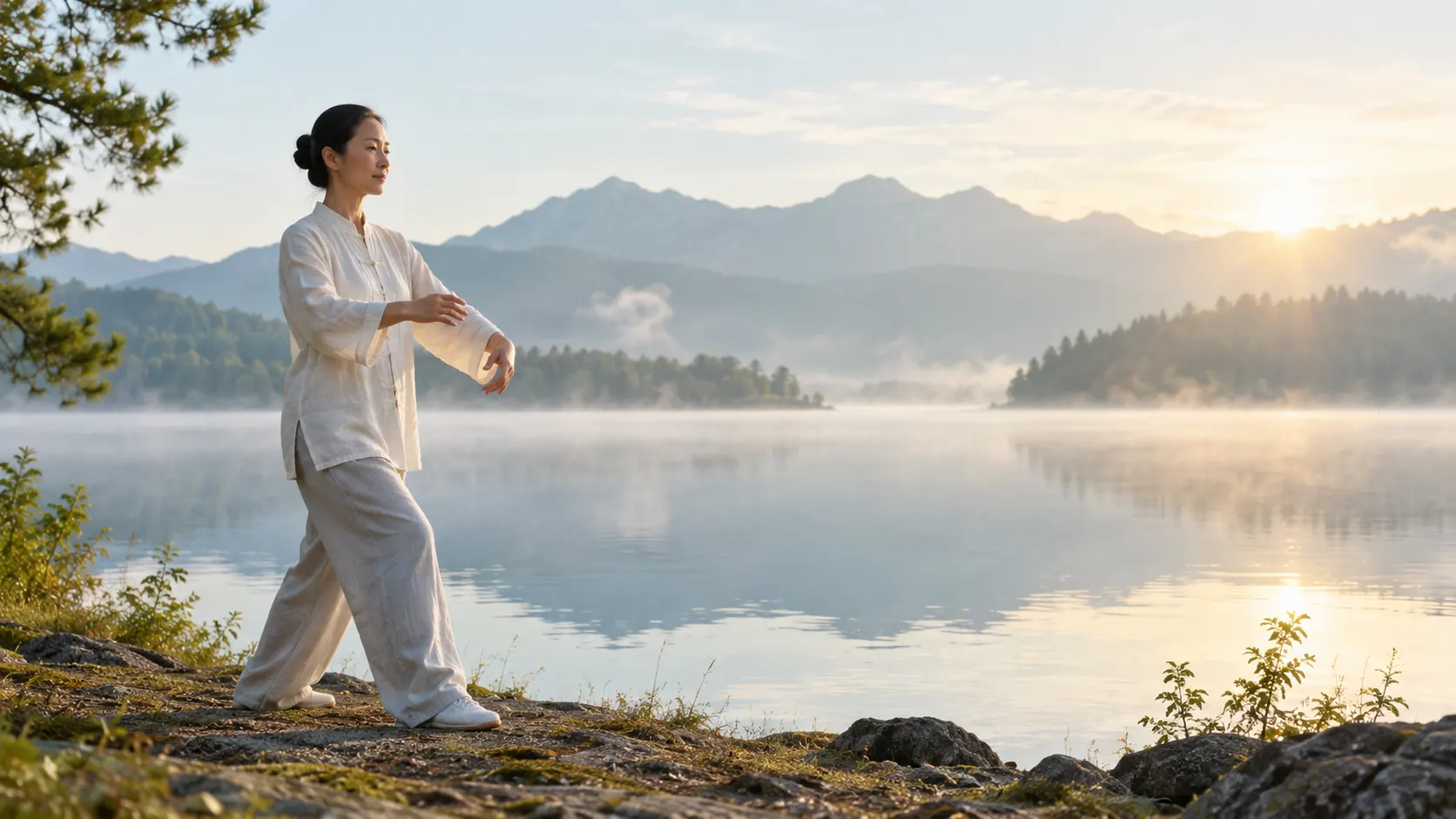
What Is Tai Chi Walking
Tai Chi is practiced as a series of controlled movements that flow from one position to another. Instead of rushing through each move, you shift your weight slowly, stay aware of your posture, and coordinate each movement with your breathing. The goal is not to move as much as possible, but to stay focused and controlled throughout the practice. Tai-Chi walking applies these principles in a simpler format. You do not need to memorize complex forms or have previous Tai Chi experience. Tai Chi originated as a Chinese martial art developed for combat and self-defense. For most practitioners, it has evolved into an exercise, a relaxation technique, and a sport.
Kinesiologist Li Li from Georgia Southern University helped bring Tai Chi walking to a wider audience through TikTok in 2025 and 2026. The viral format may look like a new fitness trend, yet the movement itself has a much longer history.

Tai Chi walking is the foundation of Tai Chi practice. It is a slow, mindful way of moving that coordinates posture, breath, balance, and intention. Unlike ordinary walking, every step in Tai Chi walking is deliberate: how the foot lands, how weight transfers, how the spine stays upright and relaxed, and how the whole body moves as one connected unit.
The name “walking” reflects the movement itself. You take controlled steps while shifting weight between your legs. It is a simplified form of Tai Chi, not a new exercise created for social media.
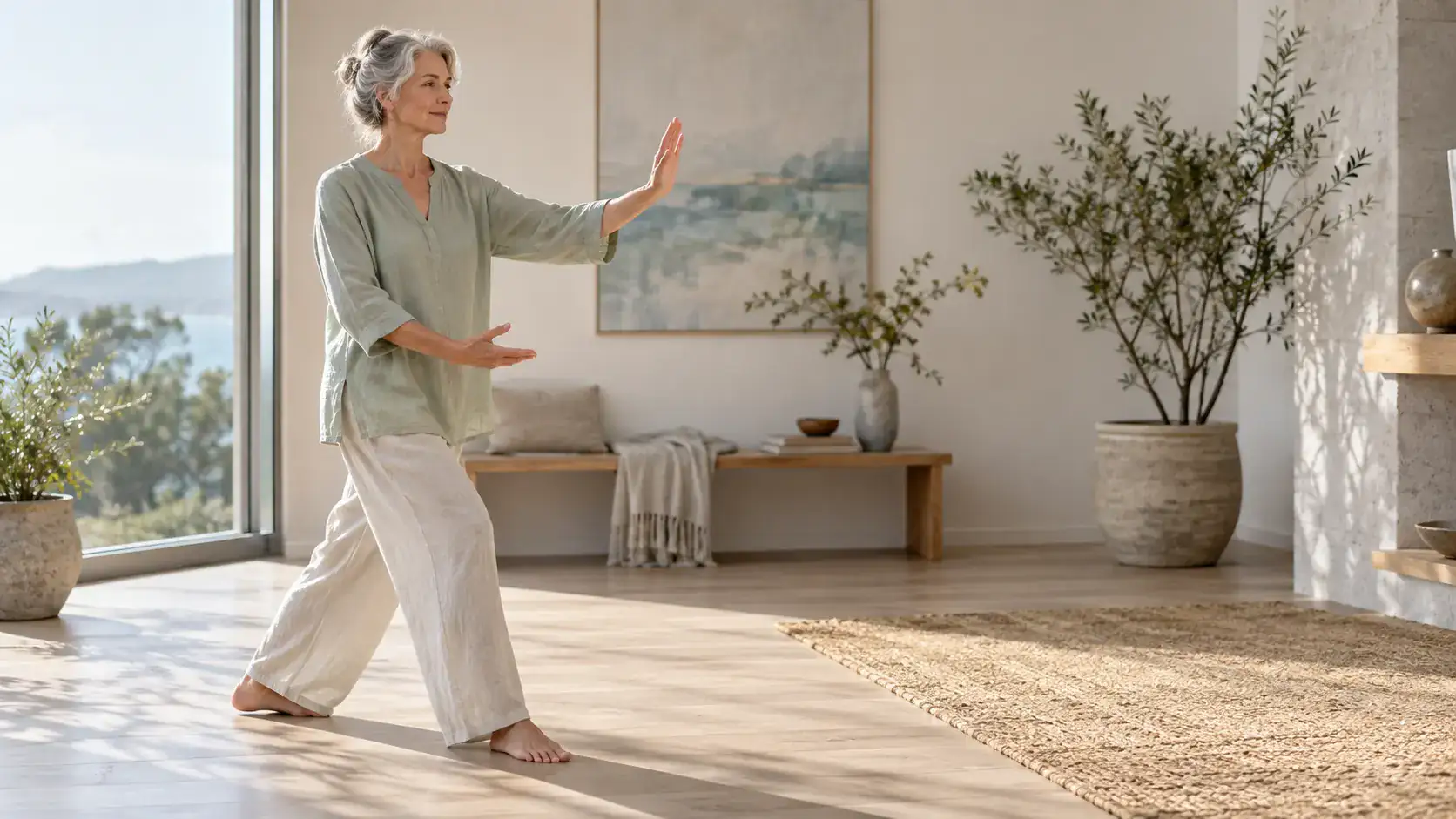
Tai Chi Walking vs. Regular Walking
Both Tai Chi walking and regular walking involve stepping forward, but their training effects can differ considerably. Regular walking usually emphasizes continuous forward movement at a comfortable or brisk pace. Tai Chi walking slows each step down so you can control your balance, weight transfer, and posture.
| Metric | Tai Chi Walking | Regular Walking |
|---|---|---|
| Pace | Very slow, around 3–5 seconds per step | Steady, around 120 steps/min |
| Focus | Foot placement, weight, breathing, posture | Pace, distance, time |
| Weight transfer | Full and controlled, with a pause | Faster and continuous |
| Muscle work | Stabilizers and balance muscles | Legs and glutes |
| Cardiovascular effect | Low | Moderate when brisk |
| Main goal | Balance and body control | Endurance and calorie expenditure |
| Beginner-friendly | Yes | Yes |
Choose regular walking for cardiovascular fitness or higher daily energy expenditure. Tai Chi walking fits better when balance and controlled movement are the priority. You can also combine them: use 5–10 minutes of Tai Chi walking before a longer walking program.
What the Research Actually Says About Tai Chi Walking
There is a lot of research behind Tai Chi, but the studies below tested traditional Tai Chi programs, not the 7-minute TikTok version. There is currently no research showing that a seven-minute routine produces the same results. Here is what the evidence can—and cannot—tell us.
Fall Prevention: About 24% Lower Risk
A 2023 meta-analysis in Frontiers in Public Health combined 24 randomized controlled trials involving older adults. Tai Chi reduced the risk of falling by 24% (RR 0.76, 95% CI 0.71–0.82). The analysis also found improvements in several balance tests. Yang-style Tai Chi showed stronger effects than Sun-style Tai Chi in the subgroup analysis.
The key point is that these results came from practicing Tai Chi regularly, usually two or three times a week. It does not mean that one short session prevents one in every four falls. It means that, across the study period, participants assigned to Tai Chi had a lower risk of falling than those in the control groups.
Tai Chi vs. Conventional Exercise
A 2018 randomized clinical trial published in JAMA Internal Medicine followed 670 adults aged 70 or older who were at increased risk of falling. Participants trained twice a week for 24 weeks. The Tai Chi group had 58% fewer falls than the stretching group and 31% fewer falls than the group doing other types of exercise.
That finding is useful because the comparison group was already exercising. The advantage was not simply that participants moved more. Tai Chi was designed around balance, postural control, weight shifting, and coordinated movement.
Stress and Anxiety
Tai Chi also has evidence beyond physical balance. A 2024 systematic review and meta-analysis indexed in PubMed included 11 trials with 1,323 participants. Tai Chi reduced perceived stress with an SMD of −0.41 (95% CI −0.63 to −0.19). Anxiety also improved, with an SMD of −0.41. Physical quality of life improved as well.
These findings are consistent with the core elements of Tai Chi: slow movement, deliberate breathing, and focused attention. However, these findings apply to Tai Chi more broadly. They don’t demonstrate that a seven-minute TikTok routine produces the same results.
The broader evidence base is substantial. In 2025, researchers from Harvard Medical School and other universities reviewed evidence on Tai Chi and qigong across musculoskeletal, cardiorespiratory, mental, cognitive, and fall-related outcomes. While one could claim that Tai Chi is beneficial, there is no proof that a 7-minute session is sufficient.
Tai Chi Walking Benefits: What the Science Confirms
The strongest evidence for Tai Chi relates to balance, fall prevention, stress, and physical function. Most studies, however, examined structured Tai Chi programs rather than the seven-minute walking routine popularized on TikTok.
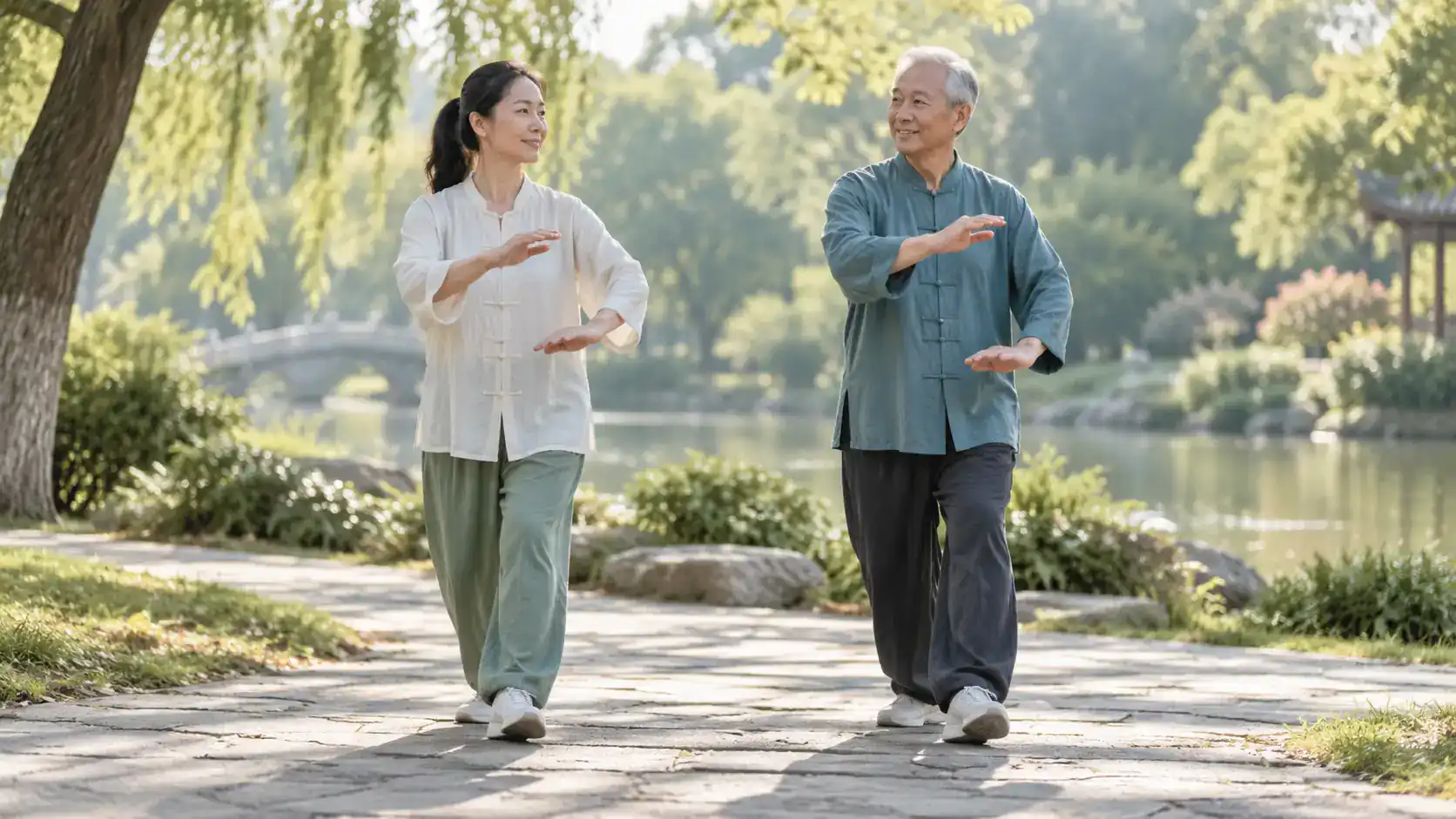
- Better balance and fewer falls. Research has linked Tai Chi with a lower risk of falls in older adults. Longer and more frequent practice may bring greater benefits.
- Less perceived stress. Tai Chi has also been associated with lower anxiety and possible improvements in mood and overall quality of life.
- Support for cognitive function. According to a 2021 systematic review and meta-analysis of 33 randomized controlled trials, Tai Chi may improve global cognitive function and executive function, particularly in middle-aged and older adults. The findings also suggest potential benefits for memory and other cognitive skills.
- Better physical function. It may look easy, but slow steps require constant control. A biomechanical study of muscle activation found that several lower-body muscles were more active during Tai Chi movements than during typical walking. This suggests that slow, controlled movements can challenge lower-body muscles and support functional movement, but they are not a substitute for resistance training.
- A well-studied form of exercise. Hundreds of clinical trials and evaluations on a variety of health issues, such as falls, physical function, mental health, cardiovascular health, and cognitive function, have focused on Tai Chi. The benefits of Tai Chi on balance, fall prevention, and physical function are most well supported.
- Better psychological well-being. According to a 2024 stress reduction review, Tai Chi was associated with lower perceived stress, while the review also assessed anxiety, depression, and quality of life.
What Tai Chi Walking Does Not Do
Tai Chi walking has clear limits. It can support balance, movement control, and stress management, yet it should not be sold as a replacement for every type of exercise.
- Build substantial muscle mass. Tai Chi walking does not provide the progressive resistance needed for significant muscle hypertrophy. If building bigger, stronger muscles is the goal, resistance training is still the better tool.
- Guarantee stronger bones. Some research indicates that Tai Chi can slow bone loss in certain populations. A 2023 umbrella review indexed in PubMed found that Tai Chi may improve bone mineral density at several sites; however, the authors rated the certainty of the evidence as low.
- Provide vigorous cardio or high calorie expenditure. Tai Chi walking is generally less demanding than brisk walking, although intensity varies by technique and pace. In one study, self-paced walking had an approximately 46% higher metabolic cost than traditional Tai Chi. However, the comparison involved Tai Chi—not Tai Chi walking—and both activities reached moderate intensity.
- Produce dramatic results in one week. Studies reporting meaningful benefits generally involve regular practice over several weeks or months. A viral seven-minute routine should not be presented as a way to lose several kilograms or transform the body within days. Being consistent is more important than how long one TikTok video is.
Is Tai Chi Walking Legit (or a Scam)?
Tai Chi walking is legit. The movement comes from Tai Chi, which has been studied in hundreds of research projects. Some fall-prevention guidelines for adults aged 65 and older include Tai Chi as a balance-focused activity. There is evidence that Tai Chi helps with function, movement, and balance.
Does Tai Chi walking really work? The viral 7-minute format needs context. It keeps some core principles, including movement, controlled weight shifts, steady breathing and careful foot placement. However, the 7-minute format removes much of the structure found in Tai Chi programs. Most research involves 30–60 minute sessions practiced for weeks or months. There is no evidence that a TikTok routine produces the same results.
This distinction matters when claims promise substantial muscle gain, five kilograms of fat loss in a week, or “reversed aging” from seven minutes of Tai Chi walking. These claims go beyond the evidence. Tai Chi walking does not provide the resistance needed for significant muscle growth, and the slow pace of Tai Chi walking makes it a poor substitute for dedicated cardio.
So, scam? No. The exercise itself is perfectly real. It is the miracle claims around it that deserve a little skepticism. Used consistently, it can support balance, coordination, and stress management without being treated as a shortcut to total fitness.
How to Do Tai Chi Walking: Tai Chi Walking Guide Step-by-Step
The sequence below reflects the basic technique shown by Li Li and George Thompson in their Tai Chi walking tutorials.
- Step 1: Get your space ready. Pick a spot where you can walk in a straight line for at least 10 steps. Going barefoot may make the floor easier to feel, but supportive, non-slip footwear may be safer for anyone with poor balance, reduced foot sensation, or foot pain.
- Step 2: Get into your starting position. Stand with your feet together, body weight evenly spread. Keep your spine upright and your shoulders relaxed. Let your arms hang naturally by your sides.
- Step 3: Shift your full weight onto one leg. Gradually shift your weight onto the left leg while staying close to a wall or stable support if needed. The right leg should feel “empty,” light enough to lift without leaning or twisting your torso.
- Step 4: Step forward with the heel. Slowly lift the right foot and place the heel down first. Keep the spine vertical. Keep your upper body quiet.
- Step 5: Roll through the foot. Move through the whole foot as your weight travels toward the toes. Aim for roughly 3–5 seconds for the transfer. Then the left foot becomes light.
- Step 6: Match your breathing to the movement. Inhale as you lift the foot. Exhale as you lower it and settle your weight. If you wobble, shorten the step. A small controlled step is better than a long compensating step.
- Step 7: Set your practice time. Start with 5–10 minutes. Once the movement feels natural, gradually work toward 15–20 minutes.
The key is control, not distance. Each step should feel deliberate, stable, and unhurried.
Tai Chi Walking for Women and for Men: Who May Benefit Most
2023 study in PLOS One looked at Tai Chi walking for women over 60. They did brisk walking and Tai Chi for 12 weeks. Participants showed measurable improvements in several physical-function tests. Their grip strength went up by 3.1 kg. They could do 2 more arm curls. They could do about 3 more chair stands. Their balance on one leg also improved by 2.2 seconds.
Fall risk increases with age. A 2020 Cochrane review found that Tai Chi may reduce this risk. Tai Chi lowers the risk of falling by 19%. This works for both women and men.
Tai Chi may also help some people manage pain and physical limitations associated with knee osteoarthritis. This condition affects women much more often than men. Harvard Health has summarized research suggesting that 12 weeks of Tai Chi may reduce knee pain and improve physical function.
There are no direct comparative studies on the effects of Tai Chi walking for men. But general meta-analyses do not show a difference in effect between the sexes. People accustomed to high-intensity or resistance training may prefer to use Tai Chi as a complementary practice.
Tai Chi Walking at Home: No Gym? No Problem!
You do not need special equipment to begin practicing Tai Chi at home.
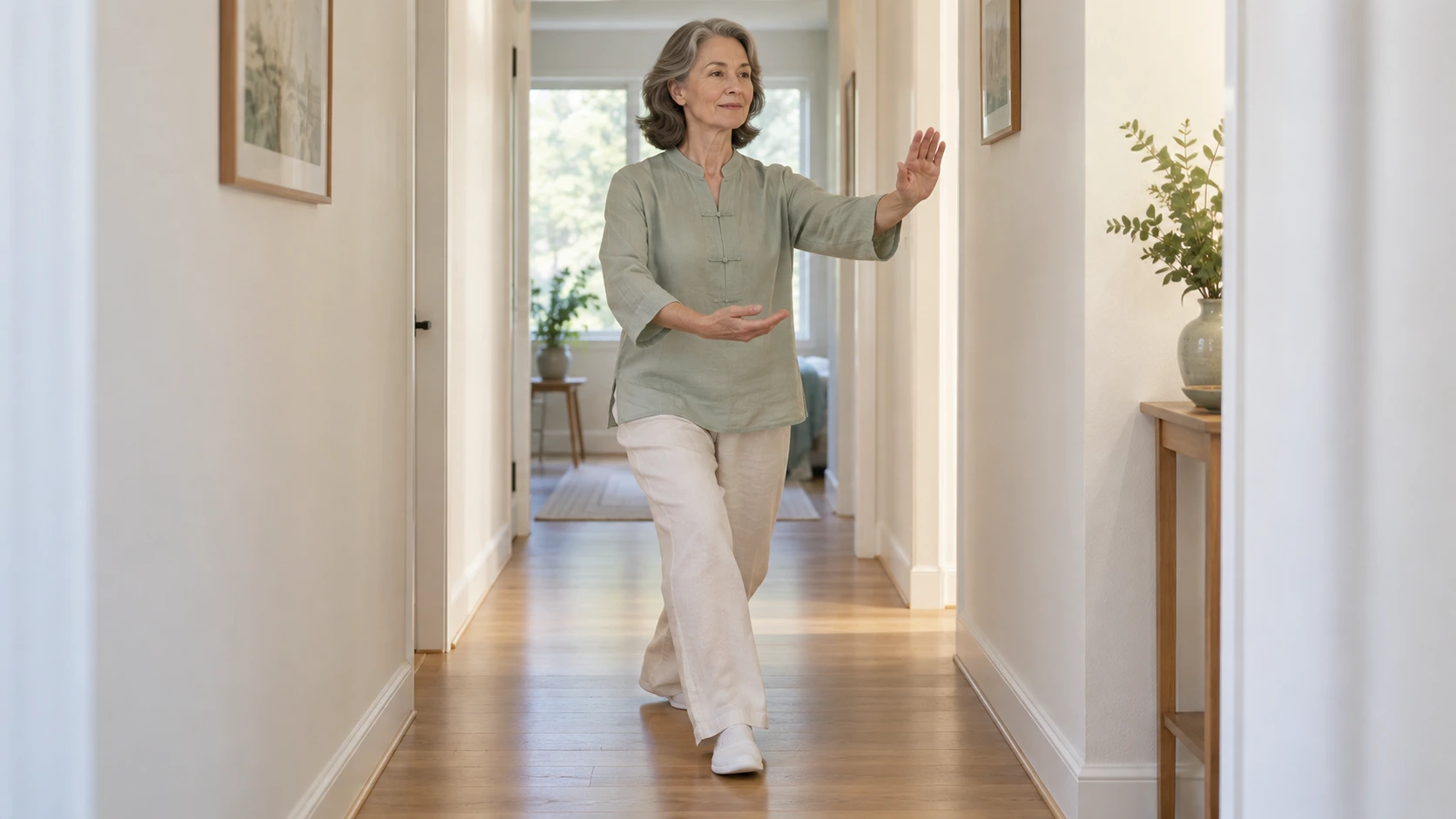
- Space. You do not need much space for Tai Chi. A clear area of roughly two square meters may be enough for basic practice. A hallway works well for several slow steps.
- Instructor? You don’t need an instructor to start. YouTube has dozens of free lessons. Search for “Tai Chi walking for beginners” and choose the one you like most. Another option is a structured Tai Chi program such as FitMe, in which an instructor guides you step by step.
- Duration & frequency. While a short 5–10-minute practice may help establish the habit, the programs studied for physical and psychological outcomes generally require consistency over time. Research shows that structured programs typically involve 45–60 minute sessions, 2–3 times a week. This provides enough time to move through warm-ups, master complex form transitions, and reach a state of mindful movement. If you are short on time, brief daily practices can help maintain momentum. Many clinical programs use longer sessions, but the evidence does not establish a universal 45–60-minute “gold standard.”
- When. Practice in the morning for a calm start or in the evening to unwind. Also, if you work from home, you can add Tai Chi after lunch as a break from sitting.
5 Mistakes That Make Tai Chi Walking “Not Work”
If Tai Chi walking feels pointless after a few attempts, check your technique before blaming the method.
- Mistake 1: Moving too fast. Each step should be slow and controlled, often taking around 3–5 seconds. At a normal walking pace, weight shifts happen far faster.
- Mistake 2: Looking down at your feet. Keep your gaze ahead. Looking down can pull the head and spine forward and make balance harder. George Thompson also emphasizes keeping the spine long and avoiding the habit of watching your feet.
- Mistake 3: Forgetting to breathe. Keep your breathing slow and natural. Many beginners hold their breath when they concentrate. Try inhaling as you lift the foot and exhaling as you lower it and transfer weight.
- Mistake 4: Expecting instant results. One or two sessions are not enough to judge a practice that relies on repetition. Tai Chi research typically uses regular sessions over several weeks or months.
- Mistake 5: Going through the motions. Attention is part of the exercise. If your mind is busy with your to-do list, you may miss the weight shift, foot pressure, and posture that make the movement useful.