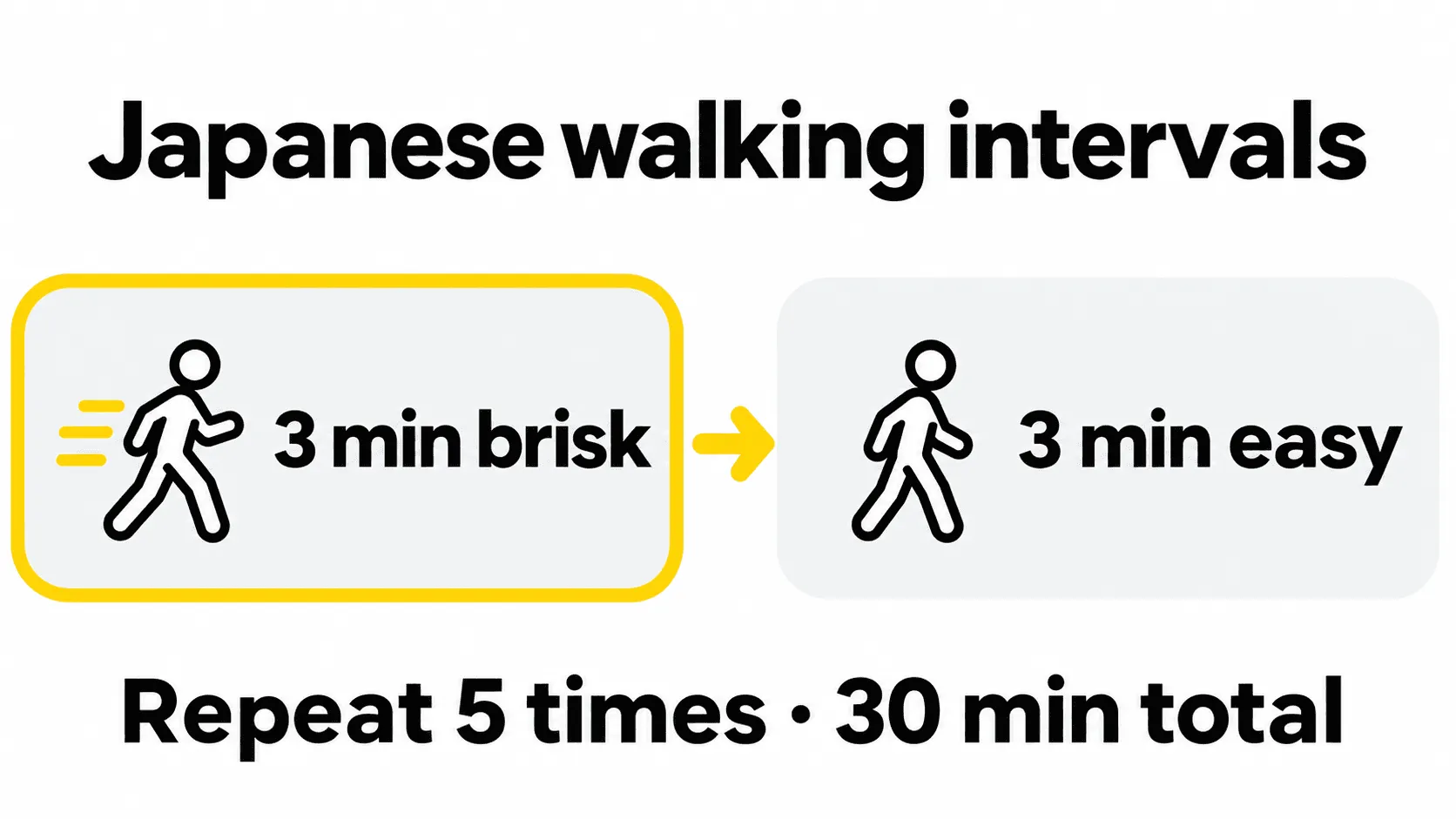
The Japanese walking method is a 30-minute interval workout that alternates three minutes of brisk walking with three minutes at an easy recovery pace. The standard protocol repeats the pair five times, usually on four or more days per week. Researchers at Shinshu University in Japan developed and studied the protocol under its scientific name, interval walking training (IWT).
In the foundational five-month trial, the interval-walking group increased knee-extension and knee-flexion strength, as well as peak aerobic capacity.
They also achieved a greater reduction in resting systolic blood pressure than participants who walked continuously at a moderate pace. The results suggest that adding controlled bursts of intensity can produce greater fitness gains than steady moderate walking.
You don’t need a heart-rate monitor or running experience to try it. A timer, comfortable shoes, and the talk test are enough. Beginners can start below the three-minute mark and extend the brisk interval each week. The full 3 × 3 format is usually introduced around week three. A doctor’s advice is appropriate before starting if joint or back pain persists, or if a health condition could affect exercise.
What Is the Japanese Walking Method?
So, what is the Japanese walking method? The idea is to change pace instead of walking at one speed throughout the session. Its research name is interval walking training, or IWT. One round pairs three brisk minutes with three easier minutes. A total of five rounds make a 30-minute session. IWT follows a work-and-recovery format similar to high-intensity interval training, with both intervals performed as walking.
However, it doesn’t require sprinting or all-out effort. The fast phase is relative to your current ability. One person may need a quick uphill walk to reach it, while another may feel the same effort on level ground.
The “Japanese” label refers to the method’s research origin. Physiologist Hiroshi Nose and colleagues at Shinshu University developed the protocol for middle-aged and older adults, and their first major trial was published in 2007. The label later became popular on TikTok and other social platforms because it was easier to remember than “interval walking training.” It doesn’t describe a traditional Japanese custom or suggest that this is how most people in Japan walk.
What the Japanese Walking Method Study Found
K. Nemoto, a researcher in the Department of Sports Medical Sciences at Shinshu University Graduate School of Medicine, was the first author of the foundational 2007 Japanese walking study . The trial enrolled 246 adults with an average age of 63 and randomly assigned them to no prescribed walking, continuous moderate walking, or IWT. For five months, the interval group was instructed to complete at least five three-minute slow and three-minute fast cycles on four or more days per week.
The interval group increased knee-extension strength by 13%, knee-flexion strength by 17%, peak aerobic capacity for cycling by 8%, and peak aerobic capacity for walking by 9%. These improvements were significantly greater than those produced by continuous moderate walking. Resting systolic blood pressure also fell more. Together, these are among the best-supported Japanese walking method benefits. The contrast between paces appears to matter because simply accumulating steps did not create the same stimulus.
Researchers Shizue Masuki, Mayuko Morikawa, and Hiroshi Nose published a 2019 Shinshu University walking study involving 679 participants that added dose-response evidence. After five months, estimated peak aerobic capacity improved by an average of 14%, while the study reported a 17% decrease in a composite score based on health risk markers. Improvements rose with weekly high-intensity walking time up to about 50 minutes but were not positively associated with slow or total walking time. This association points to the faster intervals, rather than session length alone, as the key ingredient.
A 2020 scientific review summarized the team’s large sensor-supported IWT program. Researchers, including Masuki and Nose, reached broadly similar conclusions in a 2024 review. In available studies, IWT was linked to better fitness, greater muscle strength, and changes in several health risk markers. What remains unclear is whether these results hold up over longer periods outside research programs.
The physiology of interval training helps explain why changing pace can produce these effects.
Japanese Walking vs. Regular Walking vs. Running
Cardio choice is individual. You can choose the best option based on:
• fitness level
• available time
• joint tolerance
• training goals, etc.
Calorie expenditure is also not universal. It changes with body weight, speed, incline, fitness, and duration. For the same person and duration, interval walking will generally use more energy than a relaxed walk, while running usually has the highest calorie cost per minute. You can calculate calories burned while walking with your own details using the FitMe calculator.
All three estimates use one reference: a 154 lb (70 kg) adult exercising for 30 minutes on level, firm ground. For Japanese walking, the calculation switches between 2.5 mph (4 km/h) during recovery and 4 mph (6.4 km/h) during brisk intervals. Regular walking is set at 3 mph (4.8 km/h), and running at 5 mph (8 km/h).
| Metric | Japanese interval walking | Regular walking | Running |
|---|---|---|---|
| Reference session | 30 minutes, alternating 3 minutes fast and 3 minutes slow | 30 minutes at a steady pace of approximately 3 mph | 30 minutes at a steady pace of approximately 5 mph |
| Estimated calories burned | About 155 calories | About 140 calories | About 310 calories |
| Intensity and calorie demand | Alternates easy and moderate-to-vigorous effort; generally burns slightly more than a steady moderate walk of the same duration | Usually light to moderate; calorie demand rises with pace and incline | Vigorous and generally has the highest calorie cost per minute |
| Joint impact | Low impact, although faster walking increases demand on the legs | Low impact and easy to adjust for beginners | Higher impact and more loading per step than walking |
| Equipment and skill | Supportive shoes and a timer or app; no running technique required | Comfortable shoes; no timer or structured intervals required | Suitable running shoes and enough conditioning to tolerate repeated impact |
Regular walking works well for adding more movement to the day or staying active between harder workouts. Running delivers greater intensity in less time, but it also involves more impact and requires enough conditioning to handle it comfortably. The Japanese interval walking method sits between them, offering more structure and intensity.
How to Do the Japanese Walking Method: The 3 × 3 Interval Walking Training Protocol
The intervals take 30 minutes. With a warm-up and cool-down, set aside 38 to 40 minutes for the full session.
1. Spend five minutes warming up with a slow walk on level, stable ground.
2. Continue at an easy pace for three minutes. Keep the effort at 3 to 4 on a 10-point scale. Speaking in full sentences should still feel comfortable.
3. Walk briskly for three minutes. Build to approximately 7 out of 10 effort. Your breathing should be harder, and you should manage only short phrases before another breath.
4. Repeat the easy and brisk phases five times. Five complete cycles create the standard 30-minute 3 × 3 walking routine.
5. Cool down for three to five minutes. Gradually reduce your pace instead of stopping abruptly.
The original protocol defined the fast phase as at least 70% of individual peak aerobic capacity and the slow phase as about 40%. Outside a laboratory, the talk test and perceived effort are more practical. The change in effort matters more than a specific speed.
This routine works outside, indoors, or on a treadmill. Avoid adding speed and a steep incline at the same time.
FitMe can serve as a Japanese walking method app with guided timing. Start your first interval in the FitMe app.
A Four-Week Japanese Walking Plan for Beginners
The schedule below is a practical progression, not the exact program tested in the original five-month trial. It gradually increases the duration of the brisk intervals before adding the fourth weekly session used in the research protocol.
Warm up for five minutes and cool down for three to five minutes each time. During the brisk phase, use the talk test instead of chasing a particular speed.
| Week | Sessions | Interval pattern | Main goal |
|---|---|---|---|
| 1 | 2 to 3 | 1 minute brisk + 3 minutes easy, repeated 5 times | Learn the difference between work and recovery without exhausting yourself |
| 2 | 3 | 2 minutes brisk + 3 minutes easy, repeated 5 times | Spend more time at a challenging but controlled effort |
| 3 | 3 | 3 minutes brisk + 3 minutes easy, repeated 5 times | Complete the full 30-minute interval structure |
| 4 | 4 | 3 minutes brisk + 3 minutes easy, repeated 5 times | Reach the study-based frequency while keeping the pace sustainable |
If you’d like more structure for your regular walks, explore FitMe’s walking program .
Leave a recovery day between sessions when possible during the first two weeks. A normal easy walk, mobility work, or complete rest can fill the days in between.
If a week feels too difficult, repeat it before progressing. Finishing every brisk phase at maximum effort is not the goal. You should feel challenged but still able to complete the final interval with controlled posture. Consistency matters more than reaching the full protocol on a particular date.
Safer Adjustments for Joint Pain, Higher Body Weight, and Older Adults
The Japanese walking method for seniors and beginners should be adapted to the person. That’s why there’s no universal speed. Consult a doctor before starting if you have:
• knee or back pain
• a recent operation
• balance difficulties
• a diagnosed cardiovascular, metabolic, or respiratory condition
Start on level ground. If you are using a treadmill, leave the incline at zero. Fast intervals can be limited to 30 to 60 seconds, followed by a longer recovery at a pace that feels secure. Anyone concerned about stability can choose an indoor track with a rail nearby or walk with another person. Supportive shoes and shorter, controlled steps may feel more comfortable than long strides.
Higher body weight doesn’t prevent someone from using IWT. Gradual progression and two shorter blocks may make it more comfortable.
Muscular effort and heavier breathing are expected. Sharp pain, increasing joint pain, chest discomfort, dizziness, unusual shortness of breath, or an irregular heartbeat are reasons to stop and seek medical guidance.
Common Japanese Walking Mistakes
1. Making both phases feel the same. If the fast phase still allows an effortless conversation, increase the pace slightly or choose a gentle incline. The change in effort creates the interval.
2. Turning the brisk phase into a sprint. The method uses controlled fast walking. Starting too aggressively can shorten the session and make the routine harder to repeat.
3. Skipping the warm-up. Five easy minutes give you time to check how your joints and breathing feel before the first brisk interval.
4. Progressing speed, incline, duration, and frequency together. Change one variable at a time. This makes it easier to identify what your body tolerates well.
5. Treating walking as a complete fitness program. IWT trains aerobic fitness and challenges the legs, but it does not replace dedicated resistance exercise. Adults are generally advised to train every major muscle group on at least two days each week. Our guide explains why strength training remains useful, especially during and after menopause.